What every caregiver and family member needs to know about the scams targeting seniors.
Key Takeaways
- Most scams targeting seniors don't break into a computer. They work on trust, emotion and pressure.
- Three habits stop them: Pause, Verify, Consult.
- Four signals give a scam away every time: urgency, secrecy, unusual payment and unexpected contact.
- If something has already happened, report it right away. Silence protects the criminal, not the victim.
Modern criminals are not breaking through firewalls. They stopped doing that years ago, because they found something easier to exploit and more reliably profitable. They started attacking people instead of systems.
Thirty years in cybersecurity operations brought me to that observation, and most awareness programs still miss it. The technique has a name, social engineering, and it is why technology alone cannot protect your family member. The best spam filter in the world does not stop a phone call designed to create the right emotional conditions. No antivirus prevents a grandparent from wiring money to someone they believe is a grandchild in trouble.
The threat changed, and the protection has to change with it.
That is what CyberShield Seniors is for.
Why Seniors Are Targeted
The targeting of older adults is not random. It is researched, deliberate and specific.
Older adults hold a large share of household wealth, and criminals study their targets before making contact. That research tells them exactly where to direct their operations.
But the targeting is more precise than financial assets alone. What makes it effective is the combination: decades of accumulated wealth, trust habits built in an era when institutions reliably earned that trust, and the social realities that time and distance create.
Your family member was raised in a world where banks, government agencies, physicians and local authorities were what they claimed to be. That trust was rational. It was the correct response to the world they grew up in. Criminals exploit it because it still operates as a default, and they wear the costume of every institution your family member was raised to respect without questioning.
None of this means your family member is careless or unintelligent. Being targeted is often the consequence of having built something worth protecting. The shame belongs to the person who engineered the trust in order to steal, not to the person who was deceived.
When a senior loses financial security to fraud, the impact does not stop with the account balance. Financial independence is what allows older adults to remain in their homes, keep their routines and stay connected to the people around them. That loss, and what it does to families and communities, is preventable. That is why this program exists.
The Pattern Behind Every Scam
Here is what I know from watching these operations for thirty years: every scam runs on three levers. The story changes, and the levers never do.
Trust. The criminal establishes or borrows a trusted identity: a government agency, a bank, a family member, a romantic partner. The name does the work of disarming skepticism before the conversation begins.
Emotion. Fear, urgency, love and excitement all push rational evaluation offline. The criminal needs the decision to be made emotionally, not analytically. That is by design.
Pressure. Time compression prevents recovery. "Act now." "Do not tell anyone." "This expires today." The urgency is not incidental. It is the mechanism, and the entire attack depends on the decision being made before anyone has time to pause.
When all three hit at once, with trust established, emotion elevated and pressure applied, that is when people get hurt. The confidence game has worked this way for centuries, in every culture. The tool never changed; only the channel did.
This is also why your family member can be protected against scams that have not been invented yet. When you recognize the levers, the story stops working, regardless of which story the criminal tells next.
Three Behaviors. That Is the Whole Program.
CyberShield Seniors reduces to three words.
Pause
Any request involving money, personal information, passwords or account access waits twenty-four hours, with no exceptions. Legitimate institutions always give you time. A real emergency from a real family member, a real agency or a real bank survives a twenty-four-hour delay. A scam cannot survive it, which is why the urgency itself is the red flag.
Verify
When someone contacts you about money, do not use the number or link they provide. Find the number yourself, on the official website or the back of your card, and call it directly. You do not continue a financial conversation on a channel someone else started. That one habit takes away the channel the scammer controls.
Voices can now be imitated with AI, so agree on a simple family code word before you need it. If a call from "your grandson" comes with urgency and fear, ask for the code. A real relative can give it, and a scammer cannot.
Consult
Before any money moves, one trusted person gets a call. Decide now who that person is, and tell them: "I will call you before I do anything financially unusual." That conversation takes two minutes, and it is the most powerful tool in this program, because it breaks the isolation that every scam requires to succeed.
Four Signals That Tell You Every Time
Every scam activates the same pattern. When your family member feels these signals, in any combination, that is the alarm, not the invitation to act.
Urgency. "Act now or lose everything." Real institutions always give you time, so the time pressure is itself the signal.
Secrecy. "Don't tell anyone." Scams require isolation from the people who could identify the fraud. This demand is the mechanism, not the exception.
Unusual payment. Gift cards, wire transfers, cryptocurrency. No legitimate institution, not the IRS, not a bank and not a utility company, will ever ask for payment in gift cards. That request is the tell.
Unexpected contact. They came to you; you did not initiate this. Skepticism is the correct response to any financial conversation you did not start.
One signal is enough to stop and verify. Two is enough to walk away. Three or more is enough to report it.
For Caregivers and Financial Professionals
If you support someone financially or manage assets on their behalf, you can build structural protections that work even when someone makes a mistake.
Control the urgency trigger. Agree on a mandatory twenty-four-hour delay for all non-routine financial decisions with your client or family member, before it is needed. If time pressure cannot work, the attack cannot work.
Control the secrecy trigger. Keep a trusted contact on file with every financial institution. Automated alerts to a designated family member for transactions above a threshold break the isolation that fraud requires before it can complete.
Control the authority trigger. Any inbound contact claiming to be a bank, a government agency or a utility is verified by hanging up and calling back on a number you look up yourself. Never continue a financial conversation on a channel someone else started.
Control the unusual payment trigger. Set dual authorization for large transfers to new payees. Gift card purchase alerts and wire transfer approval for new payees are available at most financial institutions, so ask for them.
These are not surveillance measures. They are structural controls, the same kind that make fraud harder to complete even when it gets through every other defense.
If Something Has Already Happened
Report it right away. Silence protects the criminal, not the victim, and the report you make today protects the next person. If money has moved, call your bank first.
| Where to go | How to reach them |
|---|---|
| Federal Trade Commission: report any scam or fraud | ReportFraud.ftc.gov |
| National Elder Fraud Hotline: free help reporting fraud against anyone 60 or older, Mon–Fri, 10 am–6 pm ET | 1-833-372-8311 |
| FBI Internet Crime Complaint Center: report scams that happened online | ic3.gov |
| National Center on Elder Abuse: information and referrals | 1-855-500-3537 (ELDR) |
| Eldercare Locator: find local help, including Adult Protective Services | 1-800-677-1116 |
| USA.gov: where to report each type of scam | usa.gov/common-scams-frauds |
The Moment That Belongs to You
Everything in CyberShield Seniors is about one thing: the moment between receiving the call and taking the action. The pause before the click. The hang-up before you call back. The text to your trusted contact before the money moves.
That moment is where criminals succeed and where they can be stopped. When Pause, Verify and Consult become habit, not rules to remember but reflexes, that moment belongs to you.
That is the protection. That is the program.
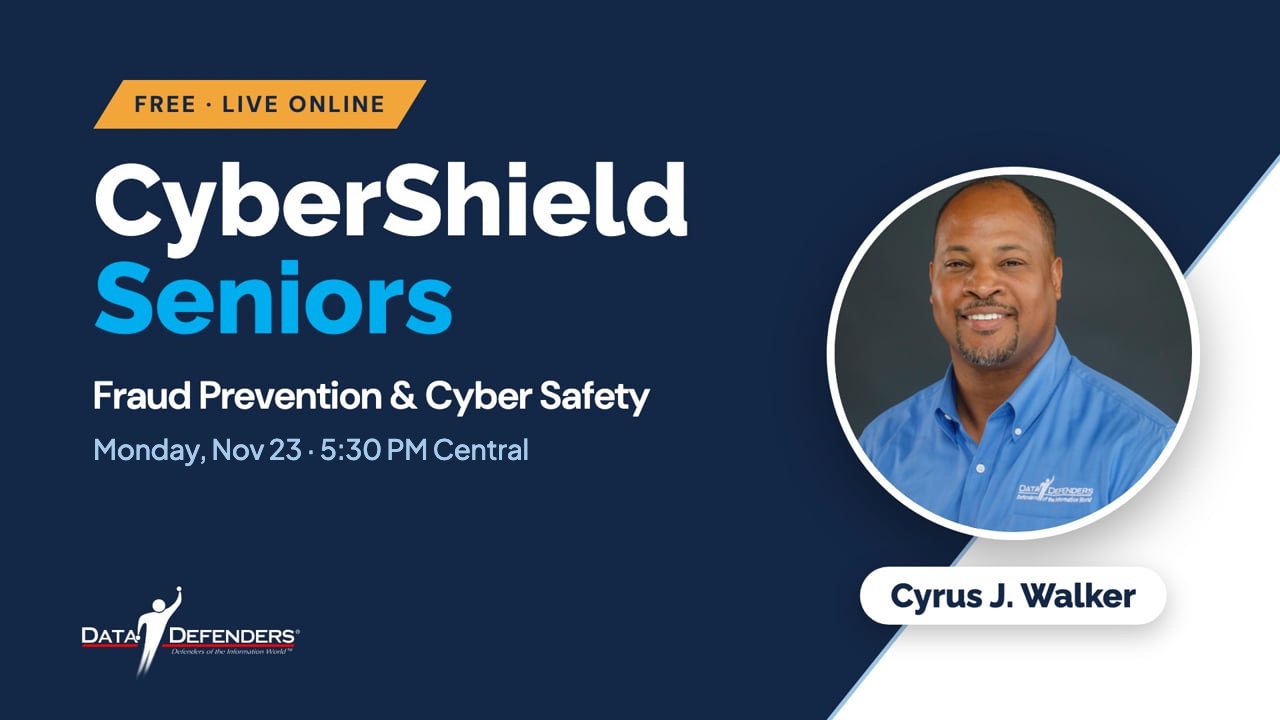
Join the free CyberShield Seniors session. Monday, November 23, 5:30–7:00 PM Central. Live and online, for older adults, their families and caregivers. Bring your questions. Register free · Watch the 60-second preview
Frequently Asked Questions
Why do scammers target older adults?
The targeting is researched and deliberate. It combines accumulated wealth, trust habits built in an era when institutions reliably earned that trust, and the social realities that time and distance create.
What is the pattern behind every scam?
Trust, emotion and pressure, arriving together. When all three hit at once, that is when people get hurt.
Is it rude to hang up on a caller who says they're from my bank?
No. "I will call you back" is a complete sentence. Hang up and call the number on the back of your card.
What should I do if a caller tells me not to tell anyone?
Treat it as the clearest signal of all. Secrecy is the mechanism of the scam, and a call to one trusted person breaks it.
Where do I report elder fraud?
Start with your bank if money has moved. Then report it to the FTC at ReportFraud.ftc.gov, or call the National Elder Fraud Hotline at 1-833-372-8311.
How can caregivers help protect an older parent?
Agree on a twenty-four-hour pause for unusual financial decisions, keep a trusted contact on file with each financial institution, and set up alerts for large or unusual transactions.
About the Author
Cyrus J. Walker III, CCFE is the Founder & CEO of Data Defenders, LLC, a Managed Cybersecurity Operations Provider serving governments, healthcare systems, businesses and nonprofits. CyberShield Seniors is available for community organizations, civic institutions, senior care facilities, financial institutions and corporate employee benefits programs. Program inquiries: cyrusjwalker.com | data-defenders.com
Resources
- Register free: CyberShield Seniors, November 23Monday, November 23, 5:30–7:00 PM Central. Live and online, for older adults, their families and caregivers.
- WatchCyberShield Seniors: the 60-second previewA short look at the free session.
- AI Is Lowering the Cost of Attacking the Communities That Can't Afford to Defend Themselveshow AI makes phishing, voice calls, and impersonation easier to produce at scale.